Palestinian Christians Condemn CUFI Summit
FOR IMMEDIATE RELEASE - July 6, 2026
Palestinian Christians Condemn CUFI Summit
On the occasion of the 21st annual Summit of Christians United for Israel (CUFI), the Palestinian Christian Alliance for Peace (PCAP) stands firmly in opposition to the organization's false, racist, and ultra-militaristic theology. It does so along with the Interfaith Action for Palestine coalition of which it is a member.
PCAP believes CUFI’s Narrative Contradicts the Message of Jesus.
According to Pastor Alex Awad of the PCAP Board, “Although CUFI presents itself as a Christian movement, its views and actions conflict with the moral and social teachings of Jesus articulated in the Sermon on the Mount. Its leaders turn a blind eye to Israel’s killing of tens of thousands of Palestinian civilians as well as thousands of Lebanese, the majority of whom are children and women, Christians and Muslims alike.” CUFI has expressed support for Israel’s destructive wars across Western Asia.
PCAP believes CUFI’s Theology Is False.
CUFI has asserted that historical Palestine belongs to the Jewish people by divine right, superseding the rights of the indigenous Palestinians. This doctrine poses an ethical contradiction, as it justifies violent displacement of the Palestinians and stealing their land, in direct opposition to the universal religious precept that theft is wrong. Numerous verses across the books of the New Testament clearly redefine the concept of the Chosen People. For example, in Galatians 3:28-29, Paul writes “There is neither Jew nor Gentile, neither slave nor free, nor is there male and female, for you are all one in Christ Jesus. If you belong to Christ, then you are Abraham’s seed, and heirs according to the promise.” The New Testament draws heavily on Isaiah 56, which extends divine inclusion to the goyim (the nations), promising that foreigners who “bind themselves to the Lord” will be brought to His holy mountain, "for my house will be called a house of prayer for all nations."
PCAP believes CUFI Is Racist.
Pastor John Hagee has made numerous hateful statements against Muslims, including insinuating that Muslim immigrants come to the U.S. as a "trojan horse" operating as terrorist cells across the United States. This is incendiary hate speech that endangers all American Muslims. While Israeli leaders venerate John Hagee, CUFI’s founding leader, many Jewish leaders have criticized him for hateful references to Jews. For example, Hagee claimed that Hitler came from a lineage of “accursed, genocidally murderous half-breed Jews” and suggested that it was Jews’ “disobedience” toward God that led to their persecution. He described Hitler as a “hunter” divinely guided to drive Jews back to Israel.
PCAP notes that CUFI Is Ultra-Militarist.
While 60 percent of Americans are critical of the U.S.-Israeli war on Iran, CUFI strongly supports it. CUFI is at the forefront of advocacy for increasing the billions of U.S tax dollars that are spent on military support for Israel. It idolizes Israel’s military prowess because it welcomes long, bloody wars that it believes will precede the defeat of the Antichrist and herald Christ’s return— when the faithful will rise to Heaven while others perish in Hell.
CUFI ignores increasing attacks by Israelis on Palestinian Christians
For decades, indigenous Palestinian Christians in the Holy Land have faced attacks by Jewish extremists. These attacks have increased dramatically in recent years, along with vandalism of Christian holy sites and cemeteries, and have been covered extensively in US media. Yet CUFI and its supporters have remained silent in the face of this mounting violence against Christians.
PCAP calls on all Americans to stand with the Palestinian struggle for a just peace based on equal rights for all the people who live in the Holy Land.
About PCAP:
The Palestinian Christian Alliance for Peace (PCAP) is a U.S.-based network of Palestinian Christians committed to promoting a just peace in the Holy Land through nonviolence, education, and advocacy. The PCAP campaign Take a Stand for the Holy Land is available at www.holylandstand.org.
Media Contact: Philip Farah
Email: pcap@pcap-us.org
Website: www.pcap-us.org
(541) 221-1938
PCAP Summer 2026 Newsletter
Despite the continuing ethnic cleansing and genocide that Israel is perpetrating against Palestinians, and despite the Israeli-U.S. war on Iran and its terrible impact on Lebanon and the entire West Asian region, we at the Palestinian Christian Alliance for Peace are imbued with our people’s spirit of Sumud, and we have faith that the justice of our cause will guide us to freedom.
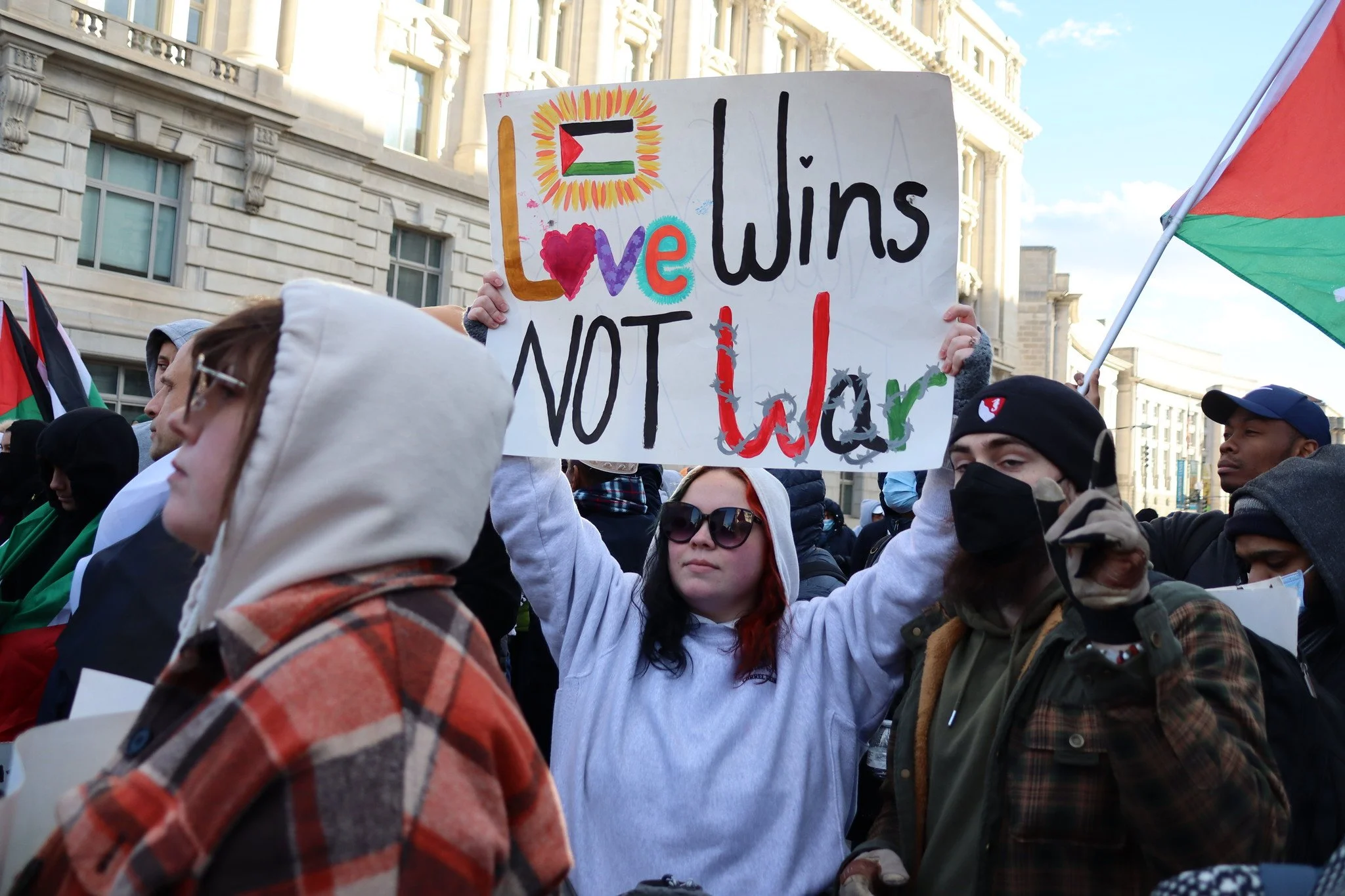
We need to hear back from you! The solidarity movement with our people has never been stronger, and it is resulting in cracks in what has historically been a united “western” front aligned with Israel. But the conditions for our emancipation require our movement to grow far stronger. We, as the voice of Palestinians Christians in the U.S., have a small but important role to play in growing our movement. So please help us by doing the following:
Spread our message more widely to the general American public; use our website, Palestinian Christian Alliance for Peace
Help us connect with more Palestinian-American Christians in your communities;
Provide us with feedback. This is especially important.
IN THIS NEWSLETTTER:
The Palestine solidarity movement is making great strides
Still, more needs to be done to alleviate the worst conditions in Palestine and West Asia for decades
The recent Gaza flotilla
Some PCAP news
Episcopal Peace Fellowship - Palestine Justice Network pledge to the Palestinian people
The Palestine Solidarity Movement Is Making Great Strides
This was the topic of a Webinar that PCAP hosted, with the Friends of Sabeel, US (FOSNA) as co-sponsor, on February 28, 2026, featuring Huwaida Arraf, a leading Palestinian American activist, known for her leadership role in organizing freedom flotillas and founding the International Solidarity Movement. The full recording of the webinar is here: Rising Global Solidarity Against Genocide: A Conversation with Huwaida Arraf
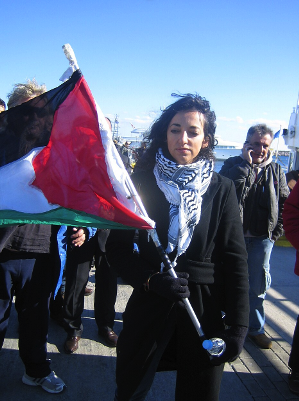
Among the greatest victories of the Palestine solidarity movement has been the growing dissent among some European Union countries from the historically solid support for Israel. This dissent is thanks to massive organizing by students, labor unions, and human rights activists. Last September, The Spanish government “announced a permanent ban on the sale of weapons and ammunition to Israel as part of a package of measures aimed at "stopping the genocide" in Gaza. Over a year before Spain’s action, Slovenia became the first EU country to ban all arms trade with Israel, including transit. Norway’s nearly $2 trillion sovereign fund, the largest in the world, divested from several of Israel’s largest companies following public pressure protesting the genocide. These included the arms manufacturer Elbit Systems and the energy firm Delek Group. Ireland, Belgium, and the Netherlands have criticized Israeli policies and expressed support for Palestinian rights.
In the U.S., while support for Israel on the federal and state levels remains strong, public opinion has been changing dramatically. In much of the two decades before 2020, American public opinion’s favorable view of Israelis was averaging above 50%, more than twice as high as it was for Palestinians. A 2026 poll indicated that sympathy for the Palestinians rose to 41%, while for Israelis it dropped to 36%.
On the grassroots level, the Palestine solidarity movement is achieving important victories. It played a very important role in Zohran Mamdani’s victory as mayor of New York City. A number of U.S. government jurisdictions have implemented divestment measures targeting Israeli assets. These include the State of Washington, Cuyahoga County in OH, the cities of Berkeley, CA, Portland, OR, Portland, ME, Somerville, MA, and others.
Faith-based groups are playing an increasingly important role in the Palestine solidarity movement. Almost all mainline Protestant denominations have responded to the movement in various ways, with some adopting economic measures such as divesting from companies that are profiting from Israel’s subjugation and oppression of Palestinians.
Several major U.S. Christian denominations, starting with the Presbyterian Church USA (PCUSA) in 2014, have divested their financial holdings from companies like Caterpillar, Motorola Solutions, and Hewlitt Packard because they profit from Israel’s occupation of Palestinian land. They’ve been joined by the Unitarian Universalist Association. The United Methodist Church (UMC), whose pension fund is over $25 billion, has divested from several Israeli banks. Since the beginning of Israel’s genocidal war in 2023, both the UMC and the PCUSA have placed a prohibition on investments in Israeli government bonds. Four U.S Christian denominations - the African American Episcopal Church, the United Church of Christ, the Disciples of Christ, and the Evangelical Lutheran Church in America - passed resolutions naming Israel’s war on Gaza and condemning it as genocide.
For more detail on church-based Palestine solidarity actions, see U.S. Churches' Palestine Solidarity Actions & Resolutions.
Faith-based solidarity is very important because, as in the case of the struggle against South African apartheid, it is crucial to take the fight from marginalized groups, such as students to the mainstream of society, forcing elected representatives to start paying attention.
Christian activists, working with secular activists and activists from other faith communities, continue to push their respective denominations to take more actions, such as campaigning to have Chevron and Palantir stop their collaboration with genocide.
At the end of this newsletter, please see one of the latest statements from a close ally of PCAP, the Episcopal Peace Fellowship Palestine Justice Network, entitled An Open Letter and Pledge to Palestinian Christians.*
Still, Much More Needs to Done for Peace and Justice
While we focus on successes of the solidarity movement and celebrate these successes, we fully recognize that facts on the ground in West Asia are abysmal. The Israeli-U.S war on Iran, and Israel’s war on Lebanon have raised to unprecedented levels the specter of disaster all over the region. U.S. military strikes on a school in Minab killed 156 people, including 120 students. Meanwhile, Israel is literally implementing a scorched-earth policy in Lebanon, destroying whole villages in the South, and intentionally killing scores of Lebanese medical workers.
Israel’s genocidal war on the Palestinians continues unabated. The following is an excerpt (with minor edits) from an article published in the Israeli online publication +972, by Gaza analyst, Mohammed Shehadeh, a writer and political analyst from Gaza who is currently a visiting fellow at the European Council on Foreign Relations. Shehadeh is describing the living conditions of his friend Anas in Gaza:
The building where Anas lives is riddled with bullet holes. The top two floors were repeatedly bombed by Israeli tanks and drones, and the ground floor has been almost completely destroyed. The staircase no longer connects to the upper three floors, leaving the building at risk of collapsing at any moment. …
There is no electricity, no running water, and no sewage or functioning bathrooms. At night, Anas sleeps with one eye open to look out for rats and mice that could bite his daughter. … During the day, Anas and his wife spend their time looking for work or humanitarian aid; their successes are painfully rare, and barely enough to keep them alive.
All day long, they are haunted by the non-stop buzzing of Israeli drones flying overhead ready to shoot to kill, as well as the sounds of explosions, machine guns, and demolition work taking place behind the “Yellow Line” — the expanding boundary marking Israel’s direct occupation of more than half of Gaza’s territory, which it is systematically flattening.
This is actually the life of one of Gaza’s luckier families, for at least they have a roof over their heads. More than six months after the so-called “ceasefire” was signed, most Palestinians in the Strip are still living in flimsy plastic tents that leak when it rains, trap the suffocating heat inside when the sun shines too brightly, and risk being blown away by moderate winds.
Few people expected the leaders of the so-called Free World to be as explicitly complicit with Israeli genocide as they have been. Not only have they failed to criticize Israel’s horrendous sadism, but they have continued to enable it by increasing the weapons shipments that are fueling the genocide. Church leaders have also been disappointingly silent in the face of the genocide. Our deep disappointment was eloquently expressed by Palestinian pastor Rev. Munther Isaac in his “Christ in the Rubble” sermon on Christmas Eve, 2023: “The hypocrisy and racism of the Western world is transparent and appalling!” While we celebrate the powerful growth in the Palestine solidarity movement all over the world, including in western countries, much more needs to be done to stop the blatant impunity of Israel in its continuing genocidal policies.
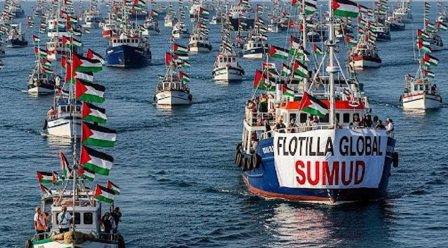
Israel Arrests and Tortures Gaza Flotilla Participants (Account from Huwaida Arraf)
On May 14, 2026, a civilian flotilla of 50 vessels carrying more than 400 volunteers from over 40 countries departed from Türkiye and Greece to challenge Israel’s illegal blockade of Gaza. The launch came just two weeks after Israeli forces attacked 22 flotilla vessels off the coast of Crete, abducting nearly 180 volunteers more than 1,000 kilometers from Gaza.
Those detained were later released in Crete and reported Israeli physical and sexual violence, threats, and degrading treatment. Despite widespread international condemnation, states took no meaningful action to hold Israel accountable. Nevertheless, the assault strengthened the determination of the flotilla volunteers to continue the mission and relaunch the effort on May 14.
Between May 18 and 19, the Israeli Navy hijacked all 50 vessels in international waters, abducting 428 volunteers and subjecting them to brutal abuse, including beatings, tasing, stress positions, sexual assault, humiliation, sleep deprivation, and psychological torture. Reported injuries included broken bones, fractured ribs, rubber-bullet wounds, as well as deep psychological trauma. Yet, as horrific as these abuses are, they are only a fraction of the violence Palestinians endure daily under a system of apartheid, settler-colonial control and ethnic cleansing.
Israeli Minister of National Security Itamar Ben-Gvir, a criminal wanted by the International Criminal Court, circulated a video taunting flotilla volunteers held in stress positions. States that were quick to condemn Ben Gvir’s deplorable video continue to arm, shield, and normalize the very system responsible for these crimes. Attempting to pinpoint responsibility on Ben Gvir follows the same pattern of shielding Israel from accountability while absolving foreign governments that make such crimes possible and routine.
International outrage ultimately secured the release of the flotilla volunteers. While we are grateful that the volunteers are now free from Israeli captivity, nearly 10,000 Palestinians remain imprisoned in Israeli dungeons and torture camps, subjected to unspeakable abuse daily with no protection or diplomatic pressure. Meanwhile, Palestinians in Gaza continue to endure genocidal conditions. Israel’s violence will not deter us. Until Palestine is free, we will continue to mobilize, organize, and resist—on land and at sea.
PCAP News
In addition to the webinar that PCAP hosted featuring Huwaida Arraf, here are a few other PCAP news items:
● PCAP sponsored a quarter-page ad in the USA Today Easter Special Edition, published on March 24, 2026. It focused on home demolitions, land confiscation and settler violence in Palestine, and stated that “a massive genocide and ethnic cleansing are under way.” The ad can be viewed of page 33 in the digital edition.
On April 23rd - 25th, PCAP hosted an information table at the annual conference of the Religion News Association in Atlanta. The conference brought together religion news writers from around the United States. Two board members and three volunteers were present to answer questions and share information about PCAP’s work and the experience of Palestinian Christians. PCAP has also exhibited at events in Washington, DC, including the Churches for Middle East Advocacy Summit and a talk by Rev. Mitri Raheb at Covenant Baptist UCC.
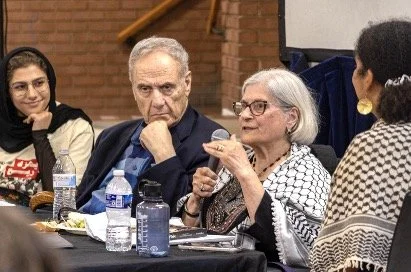
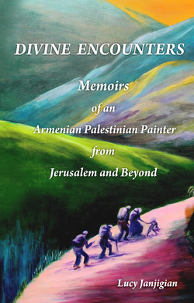
On May 23rd, PCAP Board Member Lucy Janjigian was a featured speaker in a webinar where she spoke about her experiences during the 1948 Nakba to a Presbyterian church group in Denton, TX. Lucy Janjigian is an accomplished Palestinian-Armenian artist who has also published a beautiful autobiographical book, Divine Encounters: Memoirs of an Armenian Palestinian Painter from Jerusalem and Beyond : Janjigian, Lucy: Amazon.ca: Books. Divine Encounters spans over a hundred years, starting with the Armenian Genocide in Turkey and continuing through the Israeli Genocide in Gaza. It is full of reproductions of Lucy’s paintings.
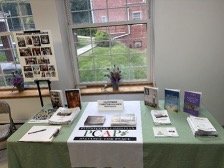
On May 16th, former PCAP Board Member Nina Bazouzi Cullers spoke at the Washington City Church of the Brethren about her experience of the Nakba as a child with her family in Jerusalem. A full account of her family’s Nakba story is included in her beautifully written autobiographical book, Living Through the Nakba: Tales of a Palestinian Youth by Nina Bazouzi Cullers | Goodreads
Rev. Alex Awad was invited to speak on June 5 to Church Women United in Eugene, and he spoke on US Complicity in Gaza's Genocide. On June 8, Rev. Awad spoke in Oregon’s capital, Salem, at a United Church of Christ. It was an interview by a person who spent many years serving in the Middle East.
Rev. Awad also met Senator Merkley of Oregon in Eugene. He and a fellow Palestinian friend presented him with a letter calling him to continue to work in Congress to stop Israel's genocide.
Rev. Awad writes regularly for The Washington Report on Middle East Affairs and has an upcoming article there titled “From Allegiance to Disillusionment: U.S. Complicity in Gaza’s Genocide.”
An Open Letter and Pledge to Palestinian Christians
08 May 2026
Dearest friends in Christ,
We write to you with unwavering solidarity, with broken hearts, and with a crushing awareness of our inability to end the nightmare in which you are living. We mourn our weakness and confess our shame at the profound moral failure of our political and our Church leaders during this most urgent crisis.
For years, our Episcopal Church has rejected appeals to name apartheid, genocide, and ethnic cleansing. It has failed to endorse a full economic and cultural boycott of the genocidal Zionist state and refused even to acknowledge Palestinians as an indigenous people of the Holy Land. It has instead adopted a cowardly and delusional stance of “engaging both sides” and “keeping open the lines of communication”. The bleak harvest of these failures and delusions is now apparent.
In times like these, where does the resurrection hope live? As you have taught us by your decades of sumud, we believe that it lives in the assurance of resistance and in the cultural and spiritual expressions of Palestinian national identity, which will shine forever amidst all efforts to extinguish them.
During these dark days and in whatever future awaits, we pledge to stand with you and to stand in opposition to the Church’s complicity of silence about genocide, ethnic cleansing, and apartheid.
With great respect and steadfast love, the Episcopal Peace Fellowship Palestine Justice Network
End of PCAP Summer 2026 Newsletter
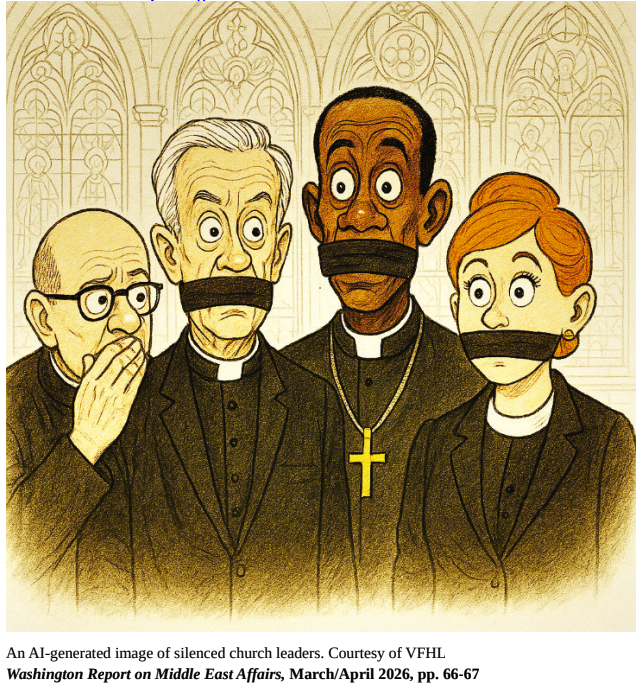
A Deafening Silence? U.S. Church Leadership in the Face of Occupation/Genocide
Philip Farah 2026 March-April Posted On February 18, 2026 https://www.wrmea.org/2026-march-april/a-deafening-silence-u.s.-church-leadership-inthe-face-of-occupation/genocide.html
Online Film Salons
By Philip Farah
HAVE CHRISTIAN LEADERS in the United States failed to name and condemn the ongoing Israeli
genocide in Gaza? As a Palestinian Christian with relatives sheltering in their Gaza churches, some of
whom were killed by Israel’s genocidal war of the last two years, the question is deeply personal for
me. The panelists featured in the December 2025 Voices from the Holy Land Online Film Salon, “A
Deafening Silence? U.S. Church Leadership in the Face of Occupation/Genocide,” grappled with this
question. The panel was co-sponsored by Christians for a Free Palestine, a new national ecumenical
organization of Christians that has grown rapidly in the past two years; and the Palestine Justice
Network of the Presbyterian Church (U.S.A.), or PCUSA.
Rev. Jeff Wright, a Colorado pastor who volunteers as a representative for Kairos Palestine (an
ecumenical movement of Palestinian Christians that raises a prophetic voice against the ongoing
oppression in Palestine), reviewed the record of church organizations’ actions on behalf of Palestinians.
He noted the long list of resolutions adopted by U.S. Christian denominations and organizations,
especially ones divesting church pension funds from companies that profit from Israeli oppression of
the Palestinians, and calling for boycotting Israeli products made in the illegal Israeli settlements built
on stolen Palestinian land. Nevertheless, he acknowledged, many U.S. Christians have expressed
“disappointment—anger, even—at the hesitation, the refusal on the part of many church leaders,
bishops [and] pastors, to name Israel’s campaign of genocide and ethnic cleansing” of Palestinians.
In 2024, Rev. Dr. Frederick D. Haynes III, pastor at the 13,000-member Friendship-West Baptist
Church in Dallas, TX, joined with a coalition of about 1,000 Black pastors in urging then-President Joe
Biden to support a ceasefire in Gaza. This was the first major action by any group of church leaders in
the U.S. to strongly challenge Washington’s support for Israel’s bloody war on the Palestinians in Gaza.
He reminded the online salon audience that Dr. Martin Luther King, Jr. had condemned U.S. crimes in
Vietnam and generally did not shy away from taking “controversial” positions even when that exposed
him to intense criticism. Rev. Haynes said it was time to “declare that silence—to the pain in Palestine
and genocide in Gaza at the hands of an apartheid regime in Israel with the support of the United States
—is betrayal.”
Following the homily, Rev. Addie Domske, a PCUSA pastor and the national field organizer for
Friends of Sabeel, USA (FOSNA), moderated a discussion by three expert panelists about the failure of
most church leaders to speak up against the genocide. FOSNA is affiliated with the Jerusalem-based
Sabeel, representing Palestinians who adhere to Christian Liberation Theology. She quoted Rev.
Munther Isaac, author of Christ in the Rubble, one of the leaders of the Kairos Palestine movement,
who said that “the Christian witness in the world is corroded if it doesn't respond to a genocide.” What
follows are key points raised by each of the three expert panelists:
• Jonathan Brenneman, a co-founder of Christians for a Free Palestine, recounted how leaders in
his Mennonite church resisted a resolution in its 2017 Convention calling for a divestment of
church funds from companies that profit from Israel’s military occupation. However, the
resolution passed with a 98 percent majority—which suggests that standing for justice is
“actually something that people were able to rally around and to feel really good about doing.”
• Rev. Dr. Don Wagner (Presbyterian minister, co-founder and former director of the Palestine
Human Rights Campaign, and an author and expert on Christian Zionism) updated Jesus’
parable in Matthew 25 to make it relevant to current conditions. Instead of “Where were you
when I was hungry? Did you bring me bread? When I was thirsty, did you give me drink? When
I was in prison, did you visit me?” today he would ask church leaders: “When I was enduring a
genocide, were you silent? Did you stand up? Did you call it a genocide, despite being accused
of being anti-Semitic?”
• Rev. Dr. Allison Tanner (national coordinator of the Apartheid-Free Initiative and Pastor of
Public Witness at Lakeshore Avenue Baptist Church in Oakland, CA) discussed the problems
with post-Holocaust history that elevates the suffering of European Jews over and against the
suffering of other peoples. While affirming that the Holocaust was a horrific manifestation of
evil, she criticized liberal Christians who associate their support for Israel with an
exceptionalism that is afforded uniquely to the Jewish victims of the Nazis, and who obfuscate
the evils done on the North American continent, which include a genocide that wiped out 90
percent of the Indigenous people and chattel slavery that lasted about 246 years. It’s very
convenient, she noted, to say that the greatest evil ever committed “happened over there with
other people.”
The panelists illustrated the tension between church leaders and the Christian grassroots, but, perhaps
because of the time constraint of the salon, they did not mention some of the most prominent examples
of the failure of U.S. church leaders in responding to the genocide. Here are a few examples:
• Catholic groups like Pax Christi and the Catholic Worker Movement have engaged in powerful
actions for peace and justice in the Holy Land over the past two years. By contrast, at the height
of the Gaza genocide in late 2024, the U.S. Conference of Catholic Bishops (USCCB) published
a 60-plus page document purporting to combat antiSemitism. The original document, entitled
“Translate Hate,” was prepared and published by the American Jewish Committee (AJC) and
was really intended to combat the solidarity movement with Palestine. The USCCB simply
added a subtitle, “the Catholic Edition,” adding limited notes on the AJC narrative from the
USCCB’s perspective.
• During the 2024 General Convention of the Episcopal Church, the House of Bishops struck
down a resolution naming Israel as an apartheid state and calling for Boycott, Divestment and
Sanctions. The resolution was supported by a majority of the House of Deputies representing
the grassroots of the Episcopal Church.
• Several Christian leaders, including president of the National Council of Churches Bishop
Vashti Murphy McKenzie and Washington Diocese Episcopal Bishop Mariann Budde, called
for Hamas to be held accountable for the Oct. 7, 2023, attack on Israel, which they described
using the harshest words. By contrast, they did not call for Israel to be held accountable for its
actions. Even when they expressed “sympathy” for dead and hungry Palestinians, they used the
passive voice, rarely mentioning the Israeli perpetrators.
The salon panelists urged attendees to acquaint themselves with the calls for justice from Palestinian
Christians, especially Kairos Palestine, and to act for justice by, for example, urging their churches to
join the call for Apartheid-Free Communities. Christians can engage with one of the many groups that
are working for a sustainable peace and equal rights for all the people of the Holy Land. Additional
examples include the following:
• Palestinian Christian Alliance for Peace is running a campaign to educate American Christians
on the plight of the Palestinians and to “Take a Stand for the Holy Land.”
• Jewish Voice for Peace is running a campaign for divestment from Israeli bonds.
• United Methodist Kairos Response recently voted to shed its investments in Israeli bonds.
• Palestine Portal provides information about numerous national and local groups involved in the
Palestine/Israel solidarity movement, including many that are Christian.
A recording of this Salon can be viewed for free at the VFHL website,
<www.voicesfromtheholyland.org/salonrecordings>, along with recordings of more than 60 other
Online Film Salons. Rev. Jeff Wright’s slides can be downloaded at <https://tinyurl.com/VFHLRevWright-slides>.
Dr. Philip Farah, a founding member of Palestinian Christian Alliance for Peace, was born in
Jerusalem and recently retired from a career as an economist in Washington, DC.